
AI in Real Estate: Trends Businesses Should Watch

The businesses pulling ahead today are not the biggest or the most established. They are the ones using AI in real estate to respond faster, understand buyers better, and convert opportunities before competitors even react.
AI in real estate includes technologies like machine learning, predictive analytics, and intelligent recommendation systems that improve how properties are bought, sold, and managed. Instead of replacing human interaction, these tools remove the delays and inefficiencies that slow businesses down.
According to a report by The Business Research Company, the global AI in real estate market was valued at USD 222.65 billion in 2024 and is projected to reach USD 1,303.09 billion by 2030.
Why AI Adoption Is Increasing in Real Estate
The real estate industry has traditionally relied on delayed communication, manual follow-ups, and disconnected systems. That approach is becoming difficult to sustain as modern buyers expect:
- Faster responses
- Personalised property suggestions
- Seamless digital experiences
- Instant communication across platforms
Businesses that cannot respond quickly are losing leads before conversations even begin. This is why companies are investing in AI to improve response times, analyse market trends faster, personalise property recommendations, and simplify property management operations.
How Real Estate Businesses Are Using AI Today
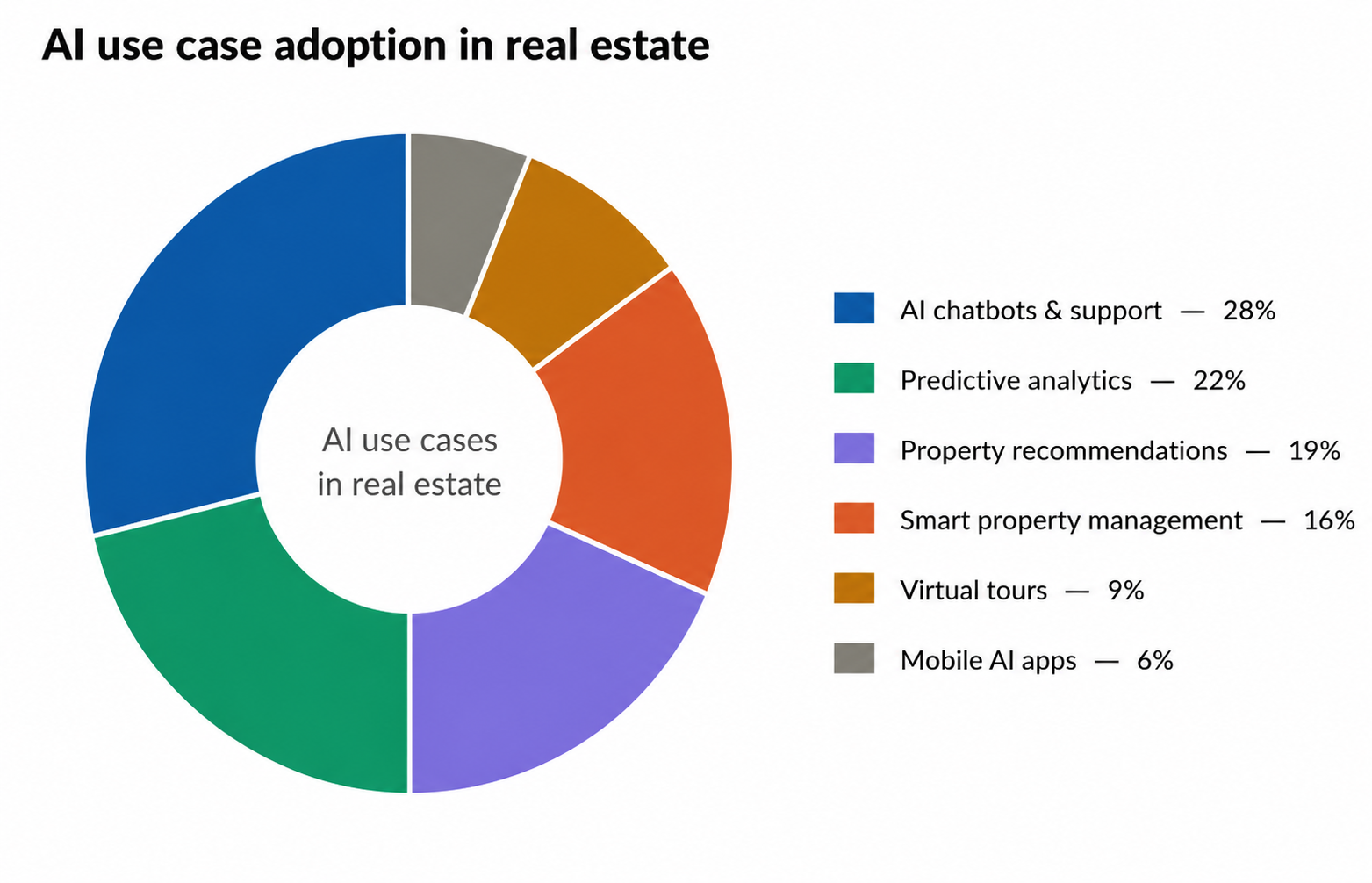
When three core functions alone account for nearly 70% of all AI activity, it is no longer a trend worth watching, it is a shift already underway
Key AI Trends Reshaping the Real Estate Industry
These are the AI capabilities businesses are actively deploying and the ones that will separate market leaders from the rest over the next three to five years.
AI-Powered Property Recommendations
Buyers now expect platforms to understand their preferences instantly. AI recommendation engines analyse search history, budget, behaviour, and location interests to suggest highly relevant properties.
This helps businesses:
- Improve engagement
- Reduce bounce rates
- Generate better-quality leads
- Increase conversion opportunities
Predictive Analytics for Smarter Investments
AI predictive analytics helps businesses make faster and more accurate investment decisions using real-time market data.
These systems can:
- Forecast demand trends
- Identify undervalued locations
- Analyse pricing patterns
- Reduce investment risks
AI Chatbots and Automated Customer Support
A buyer who inquires at 10 PM and hears back the next morning has usually moved on. AI chatbots close that gap entirely, delivering instant, intelligent responses without adding to operational headcount.
AI chatbots can:
- Capture and qualify leads
- Schedule property visits
- Answer customer inquiries
- Provide 24/7 support
Virtual Tours and AI-Enhanced Experiences
Remote and international buyers now expect to evaluate properties properly without a physical visit. AI-enhanced virtual tours go well beyond a 360-degree walkthrough.
These solutions can:
- Personalise property tours
- Recommend similar listings
- Highlight important features
- Support remote buying decisions
AI and Real Estate Mobile App Development
More than 70% of property searches begin on mobile. A well-built mobile application is no longer just a feature, it is a primary acquisition and retention channel.
Modern AI-powered apps can include:
- Smart property recommendations
- AI-powered search filters
- Integrated chatbot support
- Real-time notifications
- User behaviour analytics
Smart Property Management Solutions
AI is also improving how properties are managed after acquisition or rental. Smart management platforms automate routine operational tasks and improve efficiency.
These systems help with:
- Maintenance tracking
- Rent reminders
- Occupancy monitoring
- Tenant communication
For growing property portfolios, automation reduces operational costs and supports scalability.
AI Tools: What They Solve and Who Benefits
Now that we have covered each trend in detail, here is a quick reference to help you match the right AI tool to your business model and customer journey.
AI tool | Problem it solves | Best for |
Recommendation engine | Generic listings with low engagement | Marketplaces, rental platforms |
AI chatbot | Missed leads outside business hours | All real estate businesses |
Smart management platform | High cost of manual property operations | Portfolio managers, landlords |
Virtual tour AI | Remote buyers unable to visit in person | Luxury, NRI, international segments |
Mobile AI app | Fragmented search and engagement experience | Buyer-facing platforms |
Choosing the Right AI Real Estate Solution
Not every real estate business requires the same AI capabilities. Some businesses benefit more from AI chatbots and lead automation, while others focus on predictive analytics, recommendation systems, or smart property management platforms.
The right solution depends on your business model, customer journey, and operational goals. Businesses investing in custom software development are building platforms that improve both customer engagement and operational efficiency.
Conclusion
Businesses that move early are building data advantages, faster conversion pipelines, and customer experiences that are increasingly difficult for slower competitors to match.
AI in real estate is actively reshaping how businesses attract buyers, manage properties, analyse investments, and improve customer experiences across every digital touchpoint. From predictive analytics and personalized recommendations to intelligent chatbots and smart management platforms, the technology is proven, the ROI is measurable, and the window to move early is narrowing.
If your business is planning to build or modernise an AI-powered real estate platform, Hiteshi helps companies develop scalable digital solutions designed for how modern real estate actually operates, built for results, not just headlines.
Source: The Business Research Company
FAQs
Do buyers actually respond better to AI-powered platforms?
Yes, Platforms using personalised recommendations and instant chat support often see higher engagement, longer session durations, and lower drop-off rates compared to traditional property listing experiences.
What data does AI need to work effectively in real estate?
AI systems primarily rely on user behaviour, property data, search patterns, and market pricing information. As platforms collect more data, AI models become more accurate and effective in delivering insights, recommendations, and personalized digital experiences.
Can a small real estate team realistically use AI in real estate?
AI can be especially valuable for smaller teams because it automates tasks that would otherwise require additional staff. Follow-ups, property recommendations, and tenant communication can all be managed more efficiently through custom software solutions.
What common mistakes do businesses make when adopting AI?
One of the biggest mistakes is trying to implement too many AI solutions at once. Businesses that see the strongest results usually begin with one high-impact area, such as lead automation or recommendation engines, and expand gradually.
Does AI work for both residential and commercial real estate?
Residential real estate businesses often benefit from AI chatbots, and customer engagement tools. Commercial real estate platforms typically gain more value from predictive analytics, and smart management systems..