
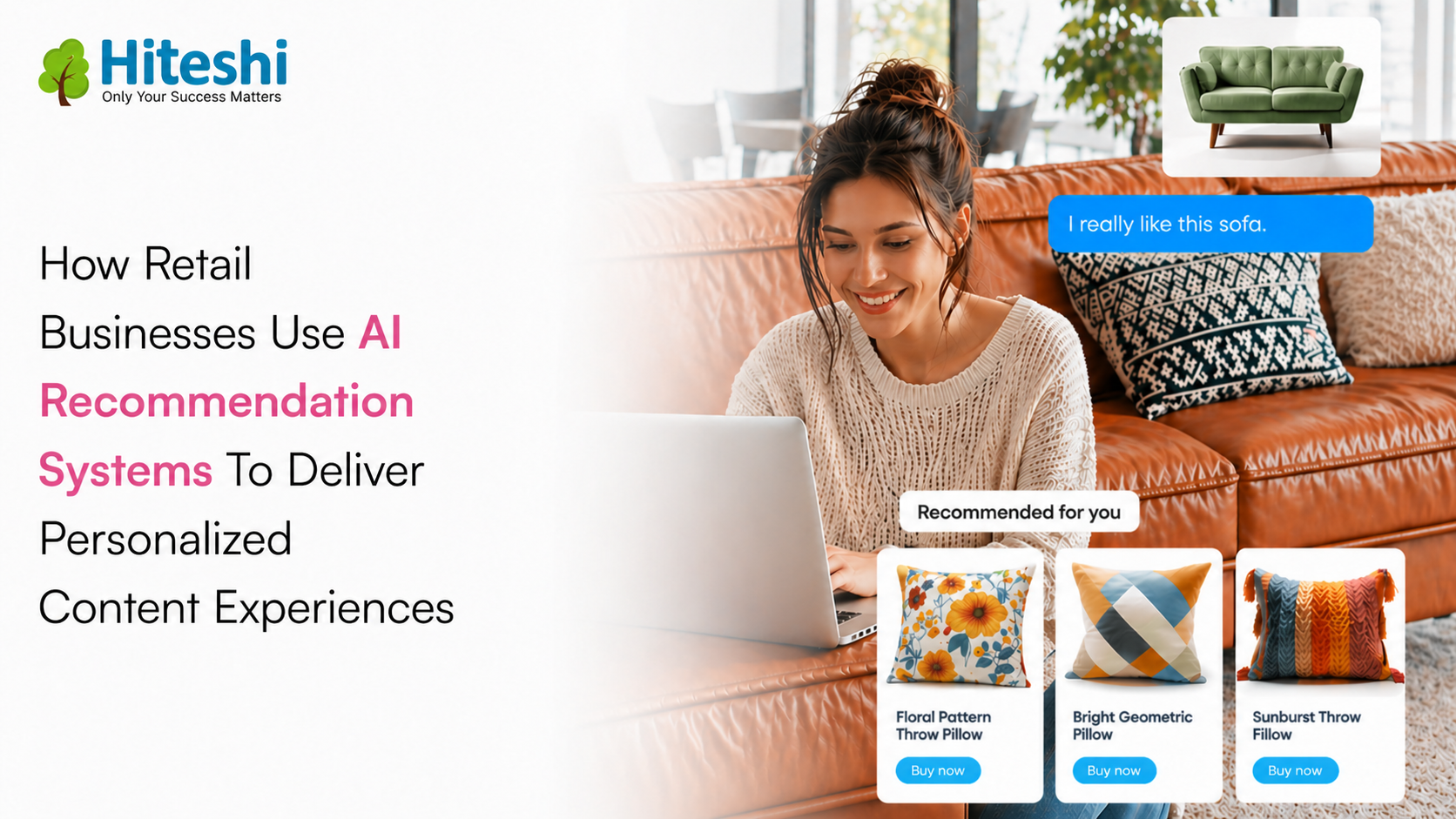
In today’s competitive retail landscape, delivering personalized shopping experiences is no longer optional. Customers expect relevant product suggestions, curated content, and seamless discovery journeys across platforms. Traditional recommendation methods often fall short due to their limited ability to understand customer intent and behaviour.
With the adoption of AI-powered recommendation systems, personalization algorithms, and user behaviour analytics, retail businesses can now provide highly tailored content experiences that improve customer engagement and drive conversions.
What Are AI Recommendation Systems in Retail?
AI-powered recommendation engines are intelligent systems that analyze customer data to suggest relevant products or content. These systems use machine learning models and behavioral data analysis to understand preferences, browsing patterns, and purchase history.
They are widely implemented in platforms offering retail software development services to enhance product discovery and digital customer experience.
Why Personalization Matters in Retail
Modern consumers interact with multiple touchpoints, making customer experience personalization critical for:
- Improving customer engagement
- Increasing conversion rates
- Enhancing customer retention strategies
- Delivering relevant product recommendations
Businesses investing in custom retail solutions rely on AI-driven personalization to stay competitive.
Core Principles of AI-Driven Personalization
1. Data-Driven Insights
Using user behavior analytics, systems analyze customer interactions to generate actionable insights.
2. Contextual Recommendations
AI systems deliver suggestions based on real-time context such as location, time, and user intent prediction.
3. Continuous Learning
Machine learning models improve recommendations over time using predictive analytics.
4. Personalization at Scale
AI enables retailers to deliver hyper-personalized experiences to thousands of users simultaneously.
5. Real-Time Processing
Instant recommendations enhance customer journey optimization and reduce decision-making time.
Key Components of AI Recommendation Systems
Data Collection Layer
Captures user interactions such as clicks, searches, and purchases using customer data platforms.
Data Processing & Analytics
Processes data using big data analytics and user behaviour tracking tools.
Recommendation Engine
Generates personalized suggestions using AI algorithms and predictive recommendation models.
Feedback Loop
Continuously refines recommendations based on user responses and real-time feedback.
Types of Recommendation Techniques
Technique | Description | Use Case |
Collaborative Filtering | Recommends based on similar user behavior | Users also bought |
Content-Based Filtering | Suggests similar items | Product recommendations |
Hybrid Models | Combines techniques | Advanced personalization systems |
Benefits of AI Recommendation Systems in Retail
Retail businesses adopting these systems gain:
- Improved customer engagement
- Higher conversion rate optimization
- Increased average order value (AOV)
- Better customer retention
- Enhanced product visibility
These benefits are essential for retail businesses looking to enhance digital experiences through advanced AI-driven solutions.
Real-World Use Cases
E-commerce Platforms
Display personalized product recommendations on homepages and product pages.
Fashion Retail
Suggest outfits using AI styling recommendations and trend analysis.
Streaming & Content Retail
Curate personalized playlists using content recommendation engines.
Challenges in Implementing AI Recommendation Systems
- Managing large volumes of customer data
- Ensuring recommendation accuracy
- Addressing data privacy and security
- Integrating with legacy systems
- Continuous model optimization
Working with experienced providers of AI software development services helps overcome these challenges.
What Makes AI Recommendation Systems Effective in Retail
For systems to deliver real value, businesses must focus on:
- High-quality data management
- Relevance-driven recommendations
- Balanced automation and human control
- Building customer trust and transparency
- Adapting to changing consumer behavior
Strategic Next Step
Retail businesses should begin by integrating AI-powered recommendation systems into key touchpoints such as product pages and homepages. Starting with a focused use case allows organizations to measure impact and optimize gradually.
Working with experienced partners like Hiteshi enables businesses to build recommendation systems that are aligned with their goals, ensuring better performance, scalability, and measurable results.
Conclusion
AI recommendation systems are transforming how retail businesses deliver personalized customer experiences. By leveraging intelligent algorithms and real-time data, retailers can create meaningful interactions that drive engagement and conversions.
As competition grows, adopting advanced personalization strategies is no longer optional but a strategic necessity. Businesses that invest in scalable and data-driven recommendation systems will be better positioned to meet evolving customer expectations and achieve long-term growth.
Source: Deloitte
FAQs
Why should retail businesses invest in AI recommendation systems?
Retail businesses often face challenges like low conversions, poor engagement, and inefficient product discovery. AI recommendation systems address these issues by delivering relevant product suggestions and enabling advanced personalization, helping businesses improve customer experience and drive measurable revenue growth.
What impact do AI recommendation systems have on key business metrics?
When implemented effectively through the right custom software solutions, they can significantly improve conversion rates, increase average order value, boost cross-selling and upselling, and reduce cart abandonment.
What factors should retailers evaluate before implementing a recommendation system?
Retailers should consider data availability, integration with existing platforms, scalability, personalization capabilities, and alignment with their customer experience goals.
Are AI recommendation systems suitable for different types of retail businesses?
Yes, they can be tailored for various retail models including e-commerce, fashion and lifestyle brands making them adaptable to different customer journeys and product categories.
What is the best way to get started with AI recommendation systems?
A practical approach is to begin with high-impact areas like product pages or homepages. Collaborating with experienced solution providers can help ensure faster deployment and better long-term results.