
AI Voice Agents for Healthcare: Transforming Patient Communication and Front-Desk Efficiency
Healthcare organizations are under constant pressure to improve patient access while managing staff shortages and rising administrative workloads. AI Voice Agents for Healthcare are emerging as a practical solution to handle routine communication, automate front-desk tasks, and reduce call center bottlenecks. However, adoption requires careful planning around compliance, clinical accuracy, and system integration.
This guide explains how voice AI works in healthcare, where it delivers value, and what decision-makers should evaluate before deployment.
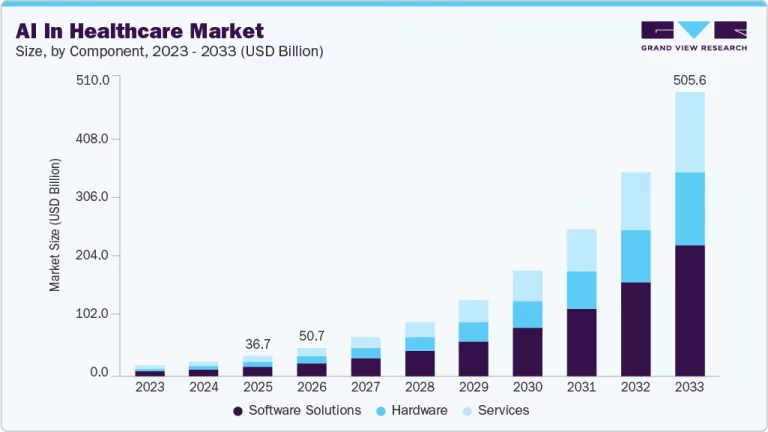
Healthcare voice assistant market projected growth and adoption rates through 2030.
(Source: Grand View Research)
What are AI Voice Agents for Healthcare?
AI voice agents for healthcare are software systems that interact with patients through natural spoken conversation. They combine:
- Automatic Speech Recognition (ASR) to convert speech into text
- Natural Language Processing (NLP) to interpret intent
- Text-to-Speech (TTS) to generate human-like responses
- Integration APIs to connect with EHR and scheduling platforms
Unlike basic IVR systems, voice agents can manage dynamic conversations.
How do AI Voice Agents for Healthcare work?
Voice AI systems follow a structured pipeline:
- Patient call input through phone or digital channels
- Speech recognition using tools like Google Speech-to-Text or Azure Cognitive Services
- Intent detection powered by NLP models
- Workflow execution such as booking or routing
- Secure documentation via EHR integration using HL7 FHIR APIs
Therefore, voice agents become an extension of the healthcare operations team.
Why are hospitals adopting voice AI in 2026?
Healthcare call volumes continue to rise. At the same time, staffing remains constrained.
Voice AI adoption is driven by:
- Increased demand for same-day scheduling
- Patient preference for phone-based support
- Need for 24/7 front-desk coverage
- Pressure to reduce administrative costs
Besides efficiency, voice agents help improve patient satisfaction by reducing wait times.
What problems do AI Voice Agents solve in patient communication?
Healthcare communication gaps often lead to missed appointments and delayed care.
Voice agents address issues such as:
- Long call hold times
- High no-show rates
- Limited staff availability
- Repetitive administrative inquiries
However, they must be designed to escalate urgent or complex cases to humans.
What are the key use cases of AI Voice Agents for Healthcare?
Appointment Scheduling and Reminders
Voice agents can book, reschedule, and confirm appointments automatically. They also send reminders, reducing missed visits.
Prescription Refill Requests
Patients often call for refill status updates. Voice AI can collect required details and route requests securely.
Billing and Insurance Support
Agents can answer common billing questions and direct patients to the right department. Therefore, call center load decreases.
Post-Discharge Follow-Ups
Hospitals can use voice calls to monitor recovery symptoms after discharge. Besides convenience, this supports early intervention.
Multilingual Patient Support
Voice agents can provide consistent service across multiple languages. However, language accuracy must be validated clinically.
AI Voice Agents vs Traditional Call Centers
Factor | Traditional Front Desk | AI Voice Agents |
Availability | Limited to office hours | 24/7 support |
Call Handling | Manual, staff-dependent | Automated for routine tasks |
Scalability | Requires more hiring | Scales with demand |
Patient Wait Time | Often high | Reduced through automation |
Limitations | Human workload strain | Requires governance and testing |
Therefore, many providers adopt a hybrid model combining AI and staff.
What are the benefits of AI Voice Agents for Healthcare?
Healthcare organizations gain:
- Faster patient response times
- Reduced administrative workload
- Improved appointment adherence
- Better access to basic support services
- More efficient call routing
Besides operational gains, voice AI improves continuity of care when integrated correctly.
Risks and compliance considerations
Voice AI systems handle protected health information (PHI). That introduces serious responsibilities.
Key risk areas include:
- HIPAA compliance: Requires encryption and access controls
- Data retention policies: Must align with healthcare regulations
- Clinical safety: Agents should not provide medical diagnosis
- Bias and fairness: Language models must be monitored
- Cybersecurity threats: Voice systems can be targeted for fraud
How do you implement AI Voice Agents for Healthcare successfully?
A phased approach improves adoption.
Assessment
- Identify high-volume call workflows
- Define patient communication priorities
Planning
- Select compliant voice AI platforms
- Establish escalation rules for urgent cases
Development
- Build conversation flows for scheduling and FAQs
- Integrate with EHR and CRM systems
Testing
- Validate clinical accuracy and usability
- Perform penetration and privacy testing
Deployment
- Start with pilot departments
- Train staff on AI-human handoffs
Monitoring
- Track call outcomes, errors, and patient feedback
- Continuously improve language performance
Therefore, voice AI becomes safer and more reliable over time.
Strategic Next Step
If your healthcare organization is exploring voice automation, begin with one operational workflow such as appointment scheduling. A specialized partner can help design compliant conversation flows and secure integrations.
Claim Your Free 30-Minute AI Consultation
Conclusion
AI-driven voice systems are reshaping patient communication by reducing front-desk workload and improving access. AI Voice Agents for Healthcare deliver value through scheduling automation, follow-ups, and faster support. However, long-term success requires HIPAA-ready security, governance, and careful clinical workflow design.
Hiteshi Infotech is a relevant service provider for organizations adopting AI Voice Agents for Healthcare, supporting compliant implementation and scalable patient engagement solutions.
FAQs
What are AI voice agents for healthcare?
AI voice agents are conversational systems that use speech recognition and natural language processing to interact with patients by phone. They support scheduling, reminders, and basic information requests.
How do AI voice agents improve front-desk efficiency?
They automate repetitive call handling, such as appointment booking and FAQs. Therefore, staff can focus on complex patient needs.
Are AI voice agents compliant with healthcare regulations?
They can be compliant if built with HIPAA safeguards, encryption, audit logs, and secure identity controls. However, governance is essential.
What are the most common use cases?
Common uses include appointment scheduling, prescription refill requests, billing support, and post-visit follow-ups.
What are the risks of voice AI in healthcare?
Key risks include privacy breaches, inaccurate responses, and workflow misalignment. Besides that, bias in language models must be monitored.