

Every day, businesses struggle with information scattered across different systems. A hospital may have diagnostic images in one platform and patient records in another, while a retailer may miss customer signals because feedback and purchase data are stored separately. These challenges highlight why multimodal AI models are becoming increasingly important for modern enterprises.
When critical information is disconnected, executives often lack the complete picture needed to make timely decisions. As organizations handle growing volumes of text, images, audio, and structured data, bringing these inputs together becomes essential.
This is where multimodal AI is changing enterprise decision-making. Companies like Hiteshi help organizations turn complex information into actionable intelligence through AI-driven solutions.
What Is a Multimodal AI Model?
A multimodal AI model is an artificial intelligence system that can process and understand multiple types of data simultaneously, including text, images, audio, video, and structured information. Unlike traditional AI models that typically focus on a single data source, multimodal AI systems combine different inputs to create a more complete understanding of information.
For example, a retailer can combine customer reviews, product images, and purchase histories, while a healthcare provider can analyze patient records alongside medical imaging data.
Why Enterprise Decision-Making Is Becoming More Complex
Decision makers are expected to make decisions quickly while managing growing amounts of information. Customer expectations, market trends, regulatory requirements, and operational challenges all add to this complexity.
Traditional AI models often analyze only one type of data at a time, leaving important information spread across different systems and formats. As a result, organizations may miss valuable insights that affect decision-making and overall business intelligence.
The Rise of Multimodal AI in Enterprises
Modern multimodal AI systems can process:
- Text documents
- Images and videos
- Voice recordings
- Sensor data
- Customer interactions
- Structured databases
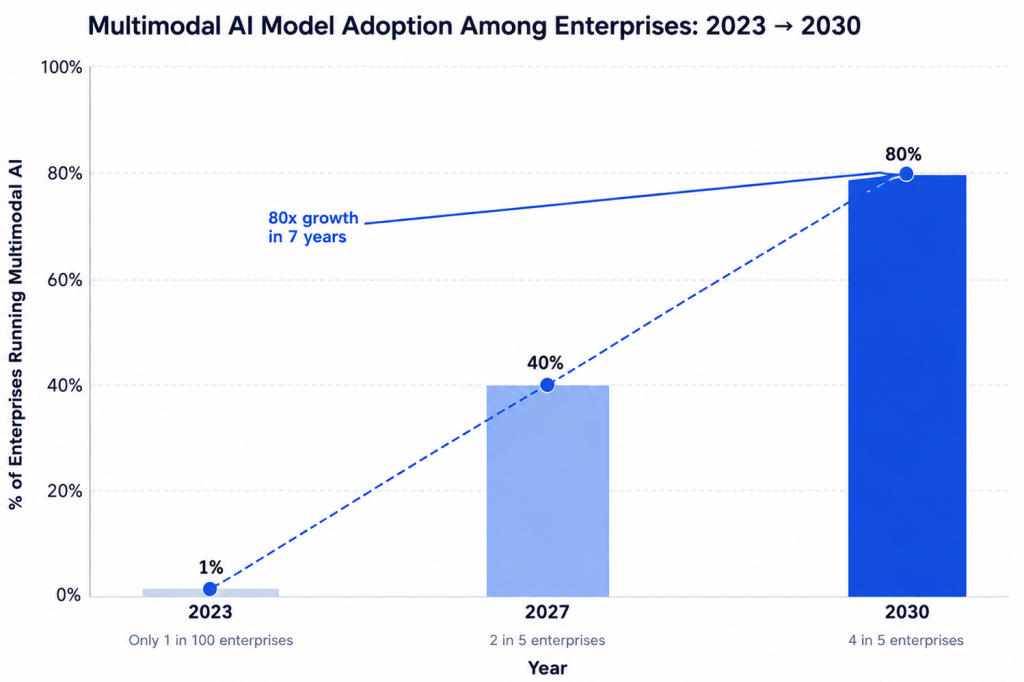
According to Gartner, 80% of enterprise software and applications will be multimodal by 2030 up from less than 10% in 2024. That’s a complete transformation of how enterprises will process and act on information within this decade.
Key Capabilities of Multimodal AI Models
As enterprises generate increasing volumes of structured and unstructured data, the ability to work with information effectively becomes just as important as collecting it. Modern multimodal AI systems offer capabilities that help organizations streamline operations and support more sophisticated business processes.
Adapting to Different Business Functions
Multimodal AI can support a wide range of applications across industries and departments. Whether used in healthcare, finance, manufacturing, retail, or customer service, these systems provide the flexibility needed to address different business requirements and scale AI initiatives over time through software development services.
Understanding Information Across Formats
Unlike single-modal systems, multimodal AI can interpret text, images, audio, video, and structured data together. This allows organizations to work with diverse information sources more effectively and gain a broader view of their operations.
Improving Information Accessibility
Information is often spread across departments, platforms, and data formats, making it difficult for teams to access and use consistently. Multimodal AI models helps organizations create a more unified view of information, enabling employees to retrieve relevant insights more efficiently.
Delivering Faster Insights
As organizations generate growing amounts of information, the ability to process and interpret data quickly becomes increasingly important. Multimodal AI enables teams to identify patterns and respond more rapidly to changing business conditions, supporting stronger business intelligence and data analytics initiatives.
Enhancing Collaboration Across Teams
Departments often rely on different systems and sources of information, which can create communication gaps and inconsistent decision-making. By providing a more connected view of information, multimodal AI helps teams work with greater alignment and supports more effective collaboration across the enterprise.
Supporting Complex Workflows
Many enterprise processes involve multiple forms of information. From analyzing documents and images to processing customer interactions and operational records, multimodal AI helps organizations manage these workflows more efficiently and reduce manual effort across teams. When combined with AI-powered services businesses can further streamline operations and improve productivity.
Enterprise Applications of Multimodal AI Models
Industry | Data Combined | Outcome |
Healthcare | Medical images + patient records | Faster diagnosis and clinical decisions |
Retail | Reviews + purchase history | Better personalization |
Manufacturing | Sensor data + visual inspections | Predictive maintenance |
Finance | Transactions + documents | Improved fraud detection |
Logistics | GPS data + inventory records | Supply chain optimization |
Customer Service | Chat, voice, and support history | Faster and more personalized support |
Emerging Trends Shaping Multimodal AI
As multimodal AI continues to mature, several developments are influencing how organizations adopt and expand these technologies.
- AI Agents – AI systems are evolving beyond content generation. Agentic AI is designed to perform tasks, coordinate actions, and interact with multiple tools and enterprise software systems with minimal human involvement.
- Real-Time Data Processing – Organizations are moving toward AI systems that process information as it is generated, supporting applications that require immediate analysis and rapid responses.
- Industry-Specific Models – Rather than relying on general-purpose AI, businesses are adopting custom software systems tailored to the requirements of their specific industry.
- Edge AI and IoT Integration – The growth of IoT devices and connected infrastructure is creating opportunities to process data from sensors, cameras, and operational systems directly at the source, without dependence on centralized platforms.
Conclusion
Enterprise decision-making depends on having the right information at the right time. As the volume and complexity of business data continue to increase, multimodal AI is evolving from an emerging capability into a strategic necessity.
Organizations that can connect information across formats will be better positioned to make faster decisions, improve customer experiences, and drive long-term innovation.
Hiteshi Infotech helps enterprises build AI-driven solutions and custom software tailored to real business needs, enabling organizations to transform complex data into measurable business value and sustainable growth.
Source: Gartner
FAQs
How do multimodal AI models work?
Multimodal AI models analyze information from different sources simultaneously and connect them to understand context more effectively. This allows them to generate more accurate predictions, responses, and insights than models that rely on a single type of data.
Why are multimodal AI models becoming popular?
Multimodal AI models are gaining popularity because they can analyze different types of data together, providing more awareness and enabling more accurate insights. This makes them valuable for applications ranging from customer service to enterprise decision-making.
What are the business applications of multimodal AI models?
Businesses use multimodal AI for customer support, predictive maintenance, fraud detection, personalized recommendations, supply chain optimization, and business intelligence.
How are multimodal AI models supporting digital transformation?
Multimodal AI models help organizations connect information across departments, automate workflows, and improve operational efficiency. As a result, they are becoming an important part of digital transformation initiatives across industries.
What is the future of multimodal AI in enterprises?
As organizations generate increasing amounts of data, multimodal AI is expected to become a key component of enterprise AI strategies. Businesses are likely to use these models to improve productivity, enhance customer experiences, and drive innovation.